Participation in the International Conference 2026 – 20–21 August 2026
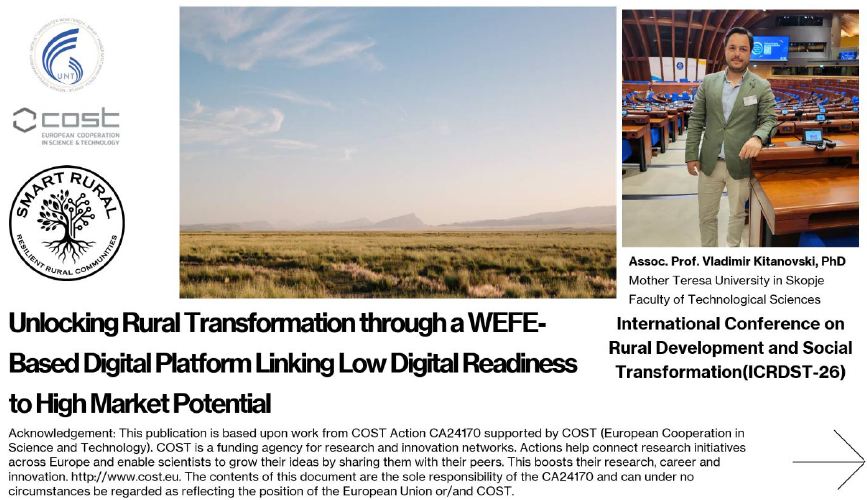
As part of the dissemination and knowledge-exchange activities of COST Action CA24170 – Building resilient rural communities through synergy of traditional knowledge and technological innovation (SMART-RURAL), Prof. Vladimir Kitanovski from the Faculty of Technological Sciences, University Mother Teresa, Skopje, North Macedonia, participated in the International Conference on Rural Development and Social Transformation (ICRDST-26), 19–20 August 2026 as a hybrid international event.
The conference brought together researchers, academics, students and professionals from different fields, providing an opportunity to exchange research results, share experiences and establish new research and professional connections. The participation provided an opportunity to present research directly relevant to the digital and sustainability dimensions of rural transformation.
Connecting rural communities with new market opportunities
The presented contribution, “Unlocking Rural Transformation through a WEFE-Based Digital Platform Linking Low Digital Readiness to High Market Potential,” explores how digitalisation can support rural communities facing persistent challenges related to limited market access, weak value-chain integration and low levels of digital readiness.
The research proposes a bidirectional digital platform that connects rural producers and service providers directly with consumers, functioning as a continuously accessible virtual marketplace. The approach is based on the Water–Energy–Food–Ecosystems (WEFE) Nexus, recognising that rural development requires an integrated perspective on resources, production, ecosystems and economic opportunities.
A Living Lab approach was established in selected municipalities in the northern and southern regions of North Macedonia. Data were collected from 37 rural production and service entities using the Rural Digital Readiness and Market Integration Assessment (RDRMIA) questionnaire. The assessment instrument was developed through an iterative expert-driven process and structured around four areas: digital literacy, market accessibility, production capacity and innovation readiness.
From low digital readiness to high willingness to innovate
The findings highlight an important opportunity for rural transformation. The assessed entities demonstrated a low level of digital readiness, with a mean score of approximately 2.3 out of 5, while at the same time showing a strong willingness to adopt digital tools. More than 80% of respondents expressed readiness to develop digital competencies for market participation.
The modelling results further indicated a significant positive relationship between willingness for capacity building and perceived potential for market integration. Importantly, no significant regional differences were identified, suggesting that the challenges and opportunities associated with rural digitalisation may extend across different geographical areas.
These results point towards an important development pathway: improving digital competencies and access to appropriate digital tools can help rural producers and service providers strengthen their connection with markets, improve competitiveness and contribute to more sustainable and shorter supply chains.
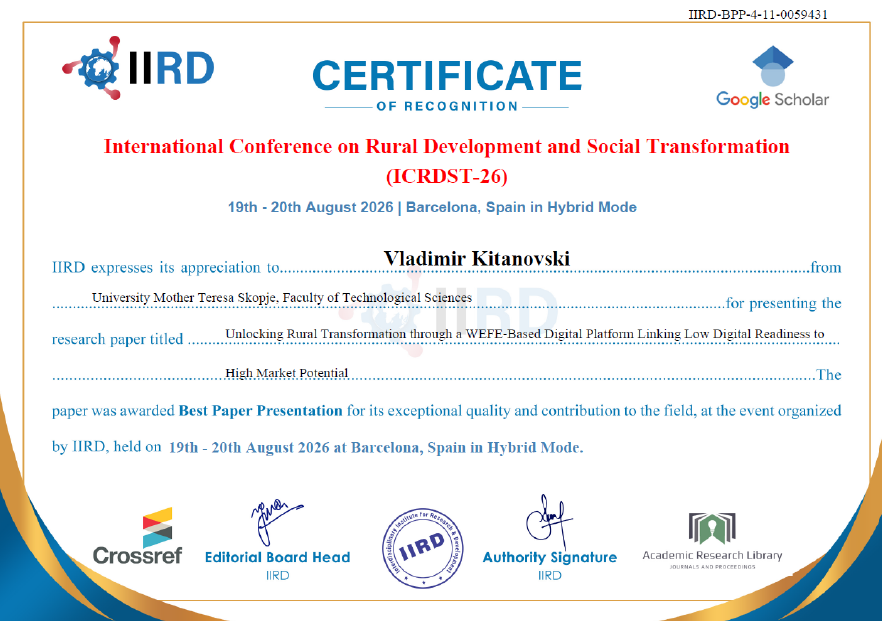
A notable outcome of the participation was the recognition of the presentation with the Best Paper Presentation Award. The conference organisers highlighted the work for its originality and research contribution, innovative approach and practical significance, presentation quality, strong methodology, and impactful research findings. A Certificate of Excellence was subsequently issued to recognise the achievement.
Relevance to SMART-RURAL
The contribution is closely connected to the objectives of SMART-RURAL, particularly its focus on strengthening the resilience and development potential of rural communities through the combination of knowledge, innovation and technology.
Digital transformation can complement local and traditional knowledge by creating new channels through which rural products, services and knowledge can reach wider markets. At the same time, the WEFE Nexus perspective provides a framework for considering rural development in an integrated way, linking economic opportunities with responsible management of water, energy, food and ecosystem resources.
Participation in the conference also created an opportunity to exchange ideas with researchers working on diverse aspects of rural development, sustainability and technological innovation. Such international knowledge exchange contributes to the broader SMART-RURAL objective of connecting expertise and strengthening collaboration across COST countries.
Looking ahead
The research highlights that digital readiness should be considered not only as a technological challenge, but also as a capacity-building opportunity. Supporting rural communities with appropriate digital competencies, innovative platforms and stronger market connections can contribute to more resilient, competitive and sustainable rural economies.
The conference participation therefore provided an important opportunity to disseminate the findings of the research, exchange knowledge with the wider scientific community and further connect the work with the objectives of COST Action CA24170.
Media content
Media content of the conference can be found at the conference organisers official media channels as follows:
- YouTube: https://www.youtube.com/@ResearchersGalleryOfficial
- Researchers Gallery: https://researchersgallery.com/videos.php
- Academic Research Library: https://academicresearchlibrary.com/abstract-detail/4446
- Our official organization websites and event pages: https://iirdglobal.com/
Acknowledgement: This publication and related dissemination activity are based upon work from COST Action CA24170 – Building resilient rural communities through synergy of traditional knowledge and technological innovation (SMART-RURAL), supported by COST (European Cooperation in Science and Technology).