

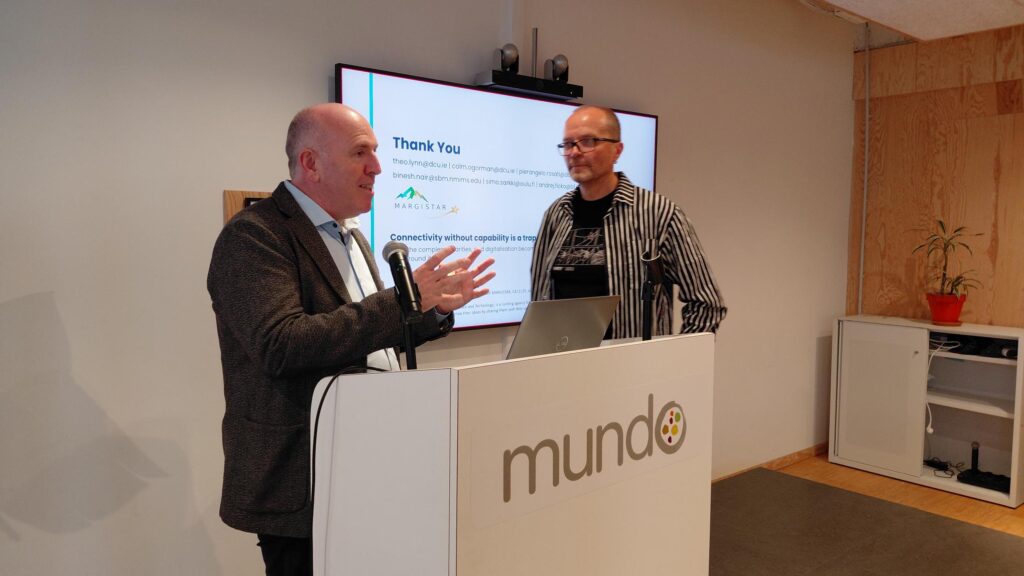
Theo Lynn attended “Overcoming Mountainous Polytraps: Policy Advice from the MARGISTAR COST Action” in Brussels on 8 September 2026 as a member of both MARGISTAR (CA21125) and SMART-RURAL (CA24170). These are his personal reflections and do not represent the positions of either Action.
Today I am at Mundo LAB in Brussels for MARGISTAR’s final event. The morning is focused on policy pitches; the afternoon looks back over four years of work on Europe’s marginalised mountain areas. I am here with two roles. MARGISTAR is finishing. SMART-RURAL is just beginning. So the question I keep coming back to is what should one hand to the other?
A useful starting point is “Escaping the Periphery Trap: Voices on the Futures of Europe’s Remote Rural and Mountain Regions” , an Issues Paper which I co-authored Colm O’Gorman, the SMART-RURAL WG2 Leader, and other colleagues across Europe.
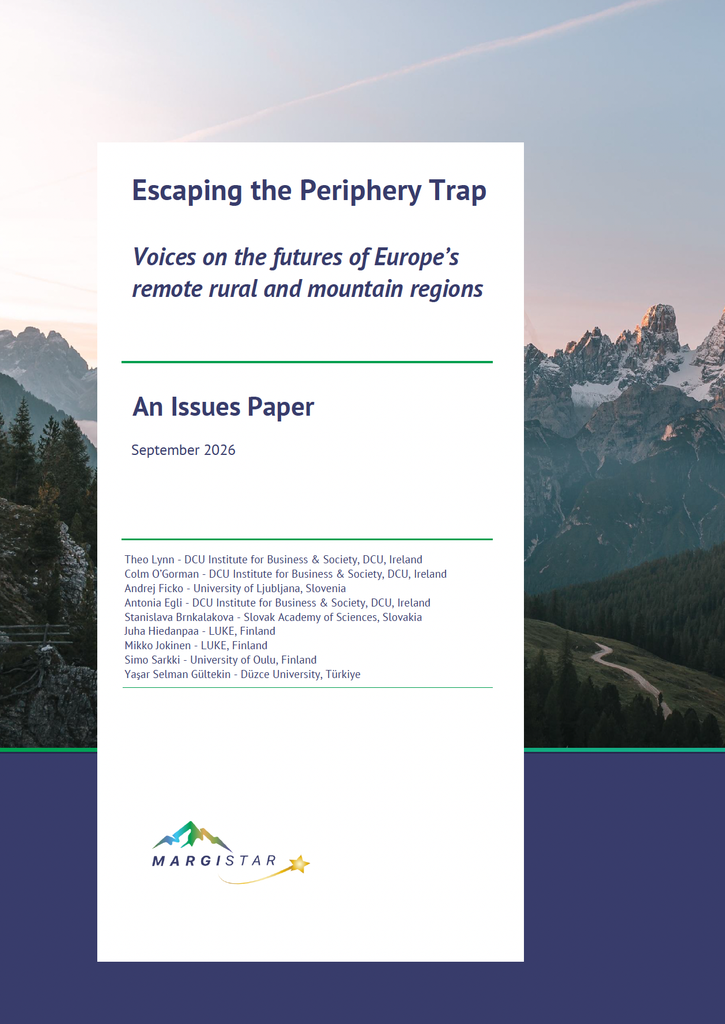
The paper brings together responses from forty experts in eighteen countries to seven foresight questions about the next ten to twenty years. Their answers point to several lessons that matter directly for SMART-RURAL. The trap is a system and perhaps the clearest message is that rural decline is rarely caused by one problem. Young people leave because housing, services, jobs and political voice are weak. Services then decline as populations fall. Farming, forestry and pastoral systems lose continuity. Landscapes change. Investment often comes from outside, with limited benefit retained locally. Climate change adds further pressure. This matters because policies still tend to deal with these problems separately: broadband here, agricultural support there, a tourism initiative somewhere else.
That is rarely enough.
SMART-RURAL starts from the same premise. Its focus on socio-economic, environmental and digital resilience recognises that these challenges interact. The Issues Paper strengthens the case for that approach: integration is not an optional extra; it is a condition for effective rural policy.
Connectivity is necessary, but not sufficient
My morning contribution focused on what I called the digitalisation trap. Thirty-three of the forty contributors discussed services and physical or digital connectivity. Many saw connectivity as essential. But they were equally clear that broadband or roads alone will not transform a place. Connectivity needs to sit alongside skills, services, employment, institutional capacity and meaningful community participation.

This is especially relevant to SMART-RURAL’s work on technology. Its plans for human-centred design, technology readiness and participatory assessment should not be treated as secondary safeguards. Technology can improve rural resilience. But poorly designed digitalisation can also centralise services, remove local capacity and leave the underlying problems untouched. When people leave, knowledge leaves too
Population decline is also about more than numbers.
Contributors repeatedly described the loss of local knowledge: pastoral practices, seasonal grazing, production cultures, land management experience and community networks built over generations. These practices are sometimes treated as cultural heritage. They are more than that. Much of this knowledge is practical knowledge about keeping landscapes productive, inhabited and resilient.
This is directly relevant to SMART-RURAL’s work on traditional knowledge and intergenerational transfer. The challenge is not simply to document old practices. It is to understand which practices still matter, how they can work alongside newer approaches, and how knowledge can remain alive rather than becoming something stored in an archive.
The delivery gap may matter more than the policy gap
Another strong message from the Issues Paper is that Europe does not necessarily lack rural policy objectives. The problem is often delivery. Contributors pointed to short funding cycles, administrative burdens, support favouring larger organisations and settlements, and policies that look good on paper but fail to reach communities. There is also a related measurement problem. Lessons from previous projects are often poorly captured, compared or scaled.
This is an area where SMART-RURAL can make a useful contribution. Its work on resilience assessment, participatory monitoring and a Rural Resilience Index could help show not only whether an intervention happened, but whether it changed anything that matters locally. That means looking beyond conventional outputs to questions such as service access, demographic viability, local value capture, landscape management, exposure to hazards and genuine local participation.
Communities need to be agents
One of the clearest statements in the paper is that local communities must be treated as agents, not objects of policy but there is also an important limitation in our own work. Thirty-eight of the forty contributors were researchers. Farmers, foresters, pastoralists, SMEs, local authorities, young people and other residents are therefore represented largely through people who work with or study them.
SMART-RURAL has an opportunity to go further. Our proposed living labs, participatory action research, citizen science and Stakeholder Advisory Board can test expert assumptions against the experience of rural communities themselves.
Three opportunities for SMART-RURAL
There are three areas where I think SMART-RURAL could build directly on this work.
First, use the rural typology to make difficult choices visible. The Issues Paper identifies recurring tensions:
- retaining residents versus attracting newcomers
- conservation with or without people
- major infrastructure versus restraint
- tourism growth versus diversification
- spreading resources widely versus concentrating them; and
- balancing local control with external integration.
These are political choices, not technical problems with one correct answer. SMART-RURAL’s typology could help identify which choices matter most in different kinds of rural communities.
Second, apply “Mountain Proofing” to technology. The Issues Paper asks whether a policy or investment improves services, creates local value, supports local knowledge, recognises risk and involves communities early enough to influence decisions. The same questions can be asked of digital technologies. SMART-RURAL’s participatory technology assessment offers a practical way to do that.
Third, test the integrated model in real places. When contributors were asked what they would change if they had the authority, many described some version of a long-term, place-based model combining reliable services, connectivity, flexible funding, environmental stewardship and local decision-making. SMART-RURAL’s pilots provide an opportunity to test parts of that model and, importantly, document what works and what does not.
The overall question is not simply how can rural regions be helped? It is how can rural communities gain the capacity and influence to shape the transitions that are already changing them?
It is a question SMART-RURAL is well placed to work on over the next four years.
Escaping the Periphery Trap: Voices on the Futures of Europe’s Remote Rural and Mountain Regions
MARGISTAR website – https://margistar.eu