Scientific collaboration is one of the most valuable ways to address today’s complex environmental and societal challenges. Thanks to the support of the SMART-RURAL COST Action, I had the opportunity to undertake a one-week Short-Term Scientific Mission (STSM) at Ca’ Foscari University of Venice, hosted by Professor Renata Sõukand, one of Europe’s leading ethnobiologists.
Returning to Ca’ Foscari was particularly meaningful for me, as I completed my postdoctoral fellowship there five years ago. This STSM provided an opportunity not only to reconnect with colleagues but also to strengthen long-term collaborations and develop new research ideas addressing the resilience of rural communities in times of crisis.
Why ethnobiology matters for rural resilience
The SMART-RURAL Action aims to strengthen the resilience of rural communities by combining traditional knowledge with innovative approaches. This objective strongly aligns with my own research interests in ethnobiology, cultural ecosystem services, and local ecological knowledge.
During the STSM, we discussed how traditional ecological knowledge contributes to rural resilience, particularly under conditions of rapid environmental and societal change. Rural communities often possess generations of knowledge about wild food plants, medicinal species, forest resources, and sustainable land management practices. These knowledge systems not only represent cultural heritage but also provide practical strategies for adapting to changing conditions.
Learning from Ukraine’s experience
A major focus of the mission was the ongoing war in Ukraine and its consequences for rural communities. Armed conflict has profoundly affected landscapes, livelihoods, and the transmission of traditional knowledge. At the same time, local communities have demonstrated remarkable resilience, relying on traditional practices, local food systems, home gardens, and ethnobotanical knowledge to cope with uncertainty.
Together with Professor Renata Sõukand, Dr. Yuliia Prakofjewa, and Dr. Raivo Kalle, we explored how these experiences could be documented and analysed to better understand the role of traditional knowledge in times of crisis and post-war recovery. These discussions reinforced the importance of preserving local ecological knowledge as both cultural heritage and a practical resource for building resilient rural futures.
Developing a new research proposal
One of the main objectives of the STSM was to develop a proposal for the Documenting Ukraine programme. Throughout the week, we worked intensively on refining the project’s objectives, conceptual framework, methodology, and expected outcomes.
The proposed project focuses on documenting how war has transformed ethnobotanical knowledge, human–nature relationships, and cultural ecosystem services in rural communities of the Ukrainian Carpathians and Transcarpathia. It aims to capture not only the losses experienced by communities but also the adaptive strategies and traditional practices that continue to support food security, well-being, and community cohesion. I am pleased that the project proposal was successfully completed and submitted shortly after the mission.
Inspiring ideas beyond the project
The STSM offered much more than proposal writing. We exchanged ideas for future collaborative publications and discussed opportunities to continue working together on ethnobiology, rural resilience, and post-war recovery.
Another inspiring aspect of the visit was learning about Professor Sõukand’s innovative educational initiatives. She introduced me to Plantacia, an educational game she developed to promote learning about plants and traditional knowledge, as well as a new Traditional Knowledge game currently under development. These creative approaches demonstrate how research can be translated into engaging educational tools that help communicate the importance of local knowledge to wider audiences.
We also discussed opportunities for broader international collaboration, including participation in the PATHWAYS Autumn School 2026, which would further strengthen interdisciplinary dialogue on biodiversity, traditional knowledge, and sustainability transformations.
Looking ahead
This STSM demonstrated the value of international scientific exchange in addressing some of today’s most pressing challenges. By bringing together expertise in ethnobiology, rural resilience, and sustainability science, we developed new ideas that extend beyond a single project and lay the foundation for long-term collaboration.
I am grateful to Professor Renata Sõukand for hosting me and for her continued mentorship and friendship, and to Dr. Yuliia Prakofjewa and Dr. Raivo Kalle for their stimulating discussions and generous hospitality. I would also like to thank the SMART-RURAL COST Action for supporting this mission and creating opportunities for researchers across Europe to collaborate on solutions for resilient rural futures.
I look forward to continuing this collaboration through future research projects, joint publications, and international initiatives that highlight the vital role of traditional ecological knowledge in supporting biodiversity conservation, sustainable rural development, and post-war recovery.
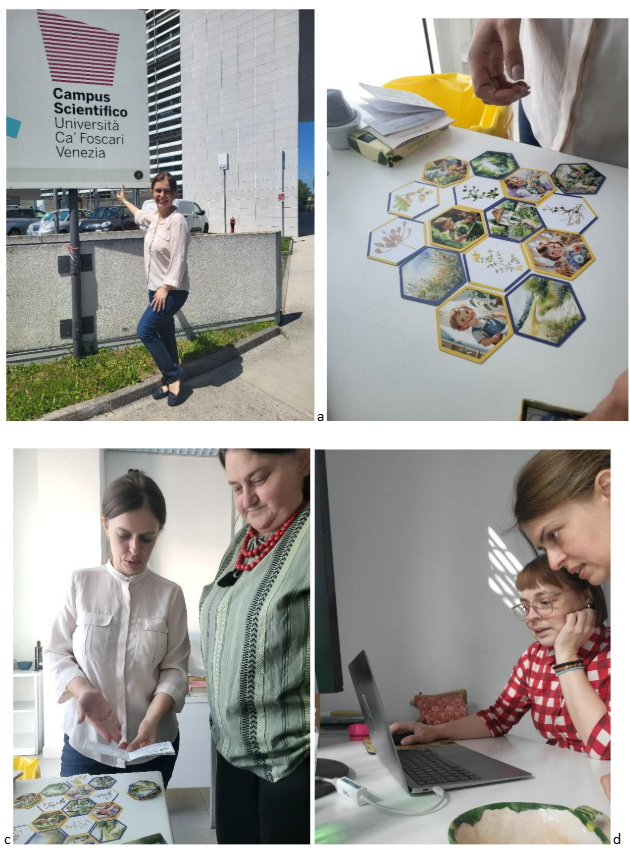
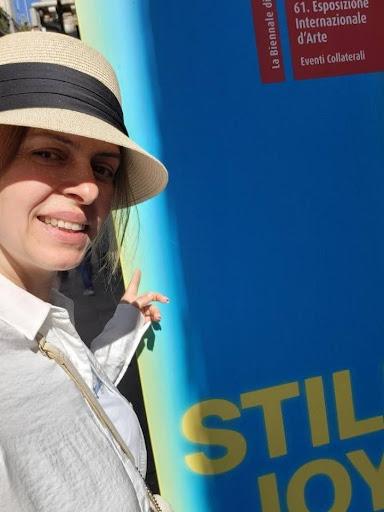
Figure 1 A- At the Ca’Foscary Campus. B – Game Plantacia developed by prof. Renata Sõukand; C-Discussion with prof. Renata Sõukand; D- discussion with Dr. Yuliia Prakofjewa ; E- On the way to main building of Ca’Foscary in Venice, see the Ukrainian stand at Biennale.